 By Hamza@globalarena.org
If you have ever seen the letters SOS in a text message, on a phone, in a movie, or during an emergency, you may have wondered: what does SOS mean?
SOS is best known as an internationally recognized distress signal. It is used to indicate that someone is facing a serious emergency and needs immediate assistance. However, the term has also become common in everyday conversations, text messages, social media posts, and smartphones.
Interestingly, SOS did not originally stand for a specific phrase. Expressions such as “Save Our Souls” and “Save Our Ship” became associated with it later.
Here is what SOS means, where it came from, and how people use it today.
What Does SOS Mean?
SOS is an internationally recognized distress signal used to request urgent help during an emergency.
It became famous through Morse code, where it is represented as:
… — …
That means three dots, three dashes, and three dots.
The pattern was particularly useful for emergency communication because it was simple, distinctive, and relatively easy to recognize.
Today, SOS has moved far beyond traditional Morse code. You might see the term used in emergency features on smartphones, safety equipment, messaging, social media, or casual conversations.
Someone might text:
“SOS! I need help with this assignment.”

In that situation, the person probably isn’t facing a life-threatening emergency. They are using SOS informally to emphasize that they need help.
The context determines how seriously the term should be interpreted.
What Does SOS Stand For?
A common misconception is that SOS officially stands for “Save Our Souls” or “Save Our Ship.”
Neither phrase was the original meaning.
SOS was selected primarily because its Morse code sequence was easy to transmit and recognize:
| Term | Meaning |
|---|---|
| SOS | International distress signal |
| Morse code | … — … |
| Save Our Souls | Popular phrase associated with SOS later |
| Save Our Ship | Another popular interpretation |
| Modern texting use | A request for help or expression of urgency |
| Emergency use | A signal indicating serious danger or distress |
The letters themselves were less important than the recognizable signal pattern.
Over time, people created memorable phrases such as “Save Our Souls” to explain the letters, but these are generally considered backronyms—phrases created after the abbreviation was already in use.
Where Did SOS Come From?
SOS has its roots in early radio communication.
Before modern phones and satellite communications, ships relied heavily on wireless telegraphy to communicate over long distances. Morse code allowed operators to transmit messages using combinations of short and long signals.
As wireless communication expanded, there was a growing need for a standardized distress signal that operators from different countries could quickly recognize.
Germany adopted the … — … distress sequence in the early 1900s. It was later selected internationally at the 1906 International Radiotelegraph Convention.
The new international regulations took effect in 1908, helping establish SOS as the standard radio distress signal.
Its simplicity was one of its biggest advantages.
Three short signals, three long signals, followed by three short signals created a distinctive pattern that could be identified even when radio conditions were poor.
Does SOS Mean Save Our Souls?
“Save Our Souls” is probably the most famous interpretation of SOS, but it is not its original definition.
The phrase became popular because it matched the three letters perfectly and made sense in an emergency.
Imagine sailors facing a dangerous situation at sea. “Save Our Souls” sounds like a natural request for rescue, which helped the interpretation become deeply connected with SOS in popular culture.
The same thing happened with “Save Our Ship.”
Both phrases are easy to remember, but SOS was not originally created as an acronym for either one.
If someone asks “What does SOS stand for?”, the most accurate answer is that SOS was chosen as a distinctive distress signal rather than as an abbreviation of a three-word phrase.
What Does SOS Mean in Morse Code?
SOS is one of the most recognizable Morse code sequences.
It is:
… — …
Breaking it down:
S = …
O = —
S = …
When transmitted as a distress signal, the sequence is recognizable because of its symmetrical pattern.
The simplicity mattered greatly during the early days of radio.
An emergency signal needed to be transmitted quickly and understood even when communication conditions were difficult. A complicated message would have been less practical.
SOS provided a short and recognizable way to communicate one critical idea:
Emergency. Assistance required.
What Does SOS Mean in Texting?
SOS has developed a much more casual meaning in texting.
When someone sends “SOS” in a message, it usually means:
“Help me.”
The level of urgency depends entirely on the situation.
For example:
“SOS, I forgot my presentation starts in 10 minutes.”
Or:
“SOS! What should I wear tonight?”
In these examples, SOS is being used humorously or dramatically rather than as a genuine emergency signal.
People often use it when they are stressed, confused, embarrassed, stuck, or urgently need someone’s advice.
It can be similar to saying:
“I need help!”
“Help me out!”
“I’m in trouble!”
“I need you ASAP!”
However, if someone sends SOS without explanation or in a situation where their safety may be at risk, it should not automatically be treated as a joke.
What Does SOS Mean on Social Media?
On social media, SOS can have several meanings depending on the post.
Someone might write:
“SOS, someone tell me how to fix this.”
Here, SOS simply emphasizes frustration.
Another person might post SOS because they genuinely need emergency assistance or want to draw attention to a dangerous situation.
It can also appear in memes and humorous posts.
For example, someone struggling to cook a complicated recipe might post a photo with “SOS.”
The term works online because most people immediately associate it with needing help.
That association remains strong even when the situation isn’t serious.
What Does SOS Mean on a Phone?
Seeing SOS on a smartphone can mean something different from receiving SOS in a text message.
Modern smartphones may display SOS when regular cellular service is unavailable but certain emergency communication options remain accessible.
The exact behavior depends on the phone, carrier, country, network availability, and device features.
Some smartphones also include an Emergency SOS feature.
These features may allow users to contact emergency services quickly using a specific button combination or gesture.
Certain newer devices can also provide emergency communication capabilities through satellite connectivity in supported locations and circumstances.
Because these are actual safety features, an SOS indicator on your phone should not automatically be interpreted as slang.
Why Is My Phone Showing SOS?
If your phone displays SOS or a similar emergency-only indicator near the signal area, your device may not currently have normal access to your cellular network.
Possible reasons include:
- Poor network coverage
- Carrier outages
- SIM or eSIM problems
- Network configuration issues
- Traveling outside your carrier’s normal coverage area
- Temporary connection problems
Your phone may still be able to make certain emergency calls depending on local networks and regulations.
Moving to another location, toggling airplane mode, restarting the phone, or checking your carrier status may resolve ordinary connection problems.
If the issue continues, checking your SIM/eSIM settings or contacting your mobile carrier can help determine the cause.
What Does SOS Mean in an Emergency?
In a genuine emergency, SOS indicates distress and a need for immediate assistance.
Historically, it was particularly associated with maritime emergencies.
A ship experiencing serious trouble could transmit the Morse code SOS signal to alert nearby stations or vessels.
Today, emergency communication technology is far more advanced, but the meaning of SOS remains widely understood.
It may be represented through:
- Radio signals
- Light signals
- Written signs
- Smartphone emergency features
- Audible signals
- Visual markings
The method changes, but the core message remains the same: help is urgently needed.
SOS vs. Mayday: Are They the Same?
SOS and Mayday are both associated with distress, but they developed for different communication methods.
SOS is historically connected with Morse code and telegraph communication.
Mayday is primarily a spoken radio distress call.
“Mayday” comes from the French expression “m’aider,” meaning “help me.”
It became useful as voice radio communication grew because operators needed a spoken distress word that could be understood clearly over radio.
In aviation and maritime radio communication, Mayday indicates grave and imminent danger requiring immediate assistance.
SOS remains culturally recognizable, but modern emergency communication follows specific procedures depending on the environment and communication system being used.
Is SOS Still Used Today?
Yes, although the technology surrounding emergency communications has changed dramatically.
SOS remains one of the world’s most recognizable symbols for distress.
Smartphone manufacturers use the term for emergency features, and emergency equipment may also carry SOS markings.
You will also frequently encounter SOS in:
- Movies and television
- Survival equipment
- Outdoor activities
- Emergency communication systems
- Text messages
- Social media
- Smartphone interfaces
Its meaning has therefore expanded.
A signal that started in the era of wireless telegraphy now exists in both serious emergency systems and casual internet language.
How Is SOS Used in Everyday Conversation?
Modern speakers sometimes use SOS figuratively.
For example:
“My laptop crashed before the deadline. SOS.”
“SOS, I have no idea what this question means.”
“I need an SOS on this project.”
These aren’t necessarily genuine emergencies.
The speaker is exaggerating their need for assistance to make the message more expressive.
It is similar to saying “rescue me” when dealing with an inconvenient situation.
This casual usage is especially common in messages between friends because the meaning is short, familiar, and immediately understandable.
When Should SOS Be Taken Seriously?
Context matters.
If your friend sends “SOS 😂 I ruined dinner,” there is probably no emergency.
But a message such as:
“SOS. Call me now.”
could be more serious.
Unexpected SOS messages from someone who may be traveling, alone, injured, lost, or in an unsafe situation deserve attention.
If there is reasonable evidence that someone’s immediate safety is at risk, contacting appropriate local emergency services may be necessary rather than relying only on text communication.
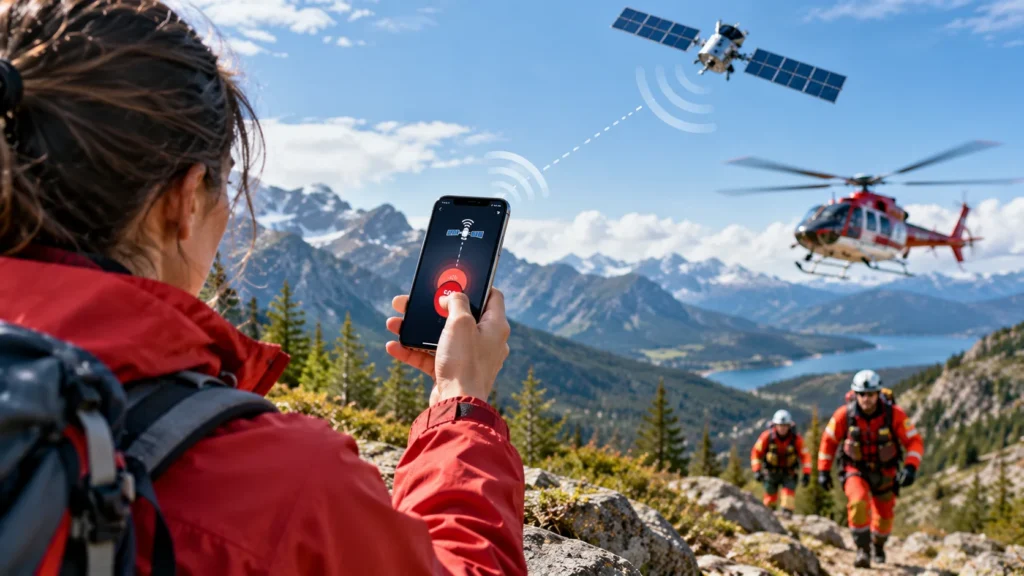
A smartphone sending an emergency SOS signal via satellite during a remote outdoor emergency.Emergency features on phones should also be treated differently from slang use. An automated emergency notification or location alert may indicate that a device’s safety feature has been activated.
Why Has SOS Remained So Recognizable?
Few communication signals survive for more than a century while remaining understandable to ordinary people.
SOS managed to do exactly that.
Part of the reason is simplicity.
Three letters are easy to remember. The Morse code sequence is distinctive. The concept behind it—asking for help—is universal.
Popular culture also played a major role.
SOS has appeared repeatedly in movies, books, television programs, songs, survival stories, and digital communication.
Even people who cannot read Morse code often know that SOS means someone needs help.
Its modern meaning has therefore become broader than the technology that originally created it.
FAQs About What SOS Means
1. What does SOS mean in simple words?
SOS means a request for help, especially during an emergency. In casual texting, people may also use it jokingly when they need advice or assistance.
2. Does SOS stand for Save Our Souls?
Not originally. “Save Our Souls” became a popular interpretation after SOS was established as a distress signal. SOS was selected mainly because its Morse code pattern was simple and recognizable.
3. Does SOS mean Save Our Ship?
“Save Our Ship” is another popular phrase associated with SOS, but it is not the original official expansion of the letters.
4. What does SOS mean in a text message?
In texting, SOS usually means “I need help” or “help me.” It can describe a real problem or be used humorously for an everyday situation.
5. What does SOS mean on an iPhone?
An SOS indicator can appear when an iPhone doesn’t have its normal cellular connection but emergency calling may still be available through another network, depending on the region and circumstances. Apple also offers Emergency SOS features on supported devices.
6. What is SOS in Morse code?
SOS in Morse code is … — … — three dots, three dashes, and three dots.
7. Is SOS only used for emergencies?
No. Its traditional meaning relates to emergencies and distress, but people now frequently use SOS casually in texts, memes, captions, and conversations to say they need help.
Final Thoughts
So, what does SOS mean?
At its core, SOS is an internationally recognized distress signal indicating that urgent help is needed. It became famous through the Morse code pattern … — …, rather than because it officially stood for “Save Our Souls” or “Save Our Ship.”
More than a century later, the term is still widely recognized. Its use has simply expanded. SOS can describe a serious emergency, appear as a safety feature on a smartphone, or show up in a casual message from someone asking for help.
The most important clue is context. An “SOS” from a friend joking about homework is very different from an SOS signal sent by someone who may genuinely be in danger.